For decades, the standard playbook for enterprise growth followed a linear hiring formula: expanding output required hiring more account executives, engineers, project managers, and operations staff. When a legacy company needed to handle 10,000 extra support tickets or review 5,000 vendor agreements, it built out call centers or contracted external business process outsourcing (BPO) agencies.
That equation is breaking down. The transition from reactive generative models (chatbots that respond to manual prompts) to autonomous AI agents—systems capable of independent planning, iterative tool usage, self-correction, and API orchestration—has decoupled organizational headcount from operational output.
A startup or small agency operating with 5 to 15 full-time employees can now deploy an internal network of autonomous agents to handle tier-1 and tier-2 customer operations, cross-platform media optimization, inbound sales qualification, and continuous data reconciliation at corporate enterprise volumes.
What Makes an Autonomous Agent Different from Standard AI Automation?
Traditional enterprise automation relies on deterministic logic: If Event A occurs via Webhook, execute Action B via API. If any step encounters an unexpected edge case—such as a changed data field, a rate limit, or an ambiguous email inquiry—the script breaks, throwing an exception that requires manual human triage.
Early generative AI tools improved communication speed, but remained passive copilot engines. A human had to write a prompt, evaluate the output, copy-paste it into an external system, and initiate downstream execution.
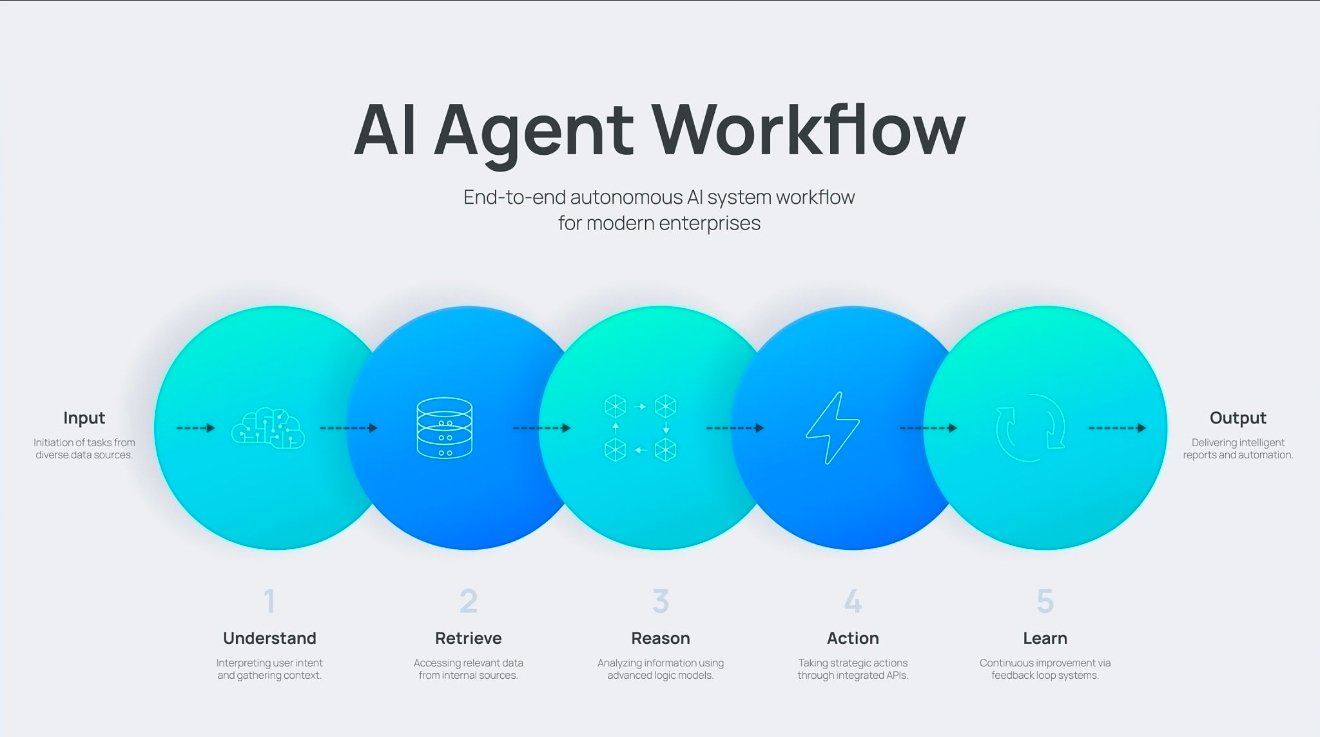
Autonomous AI agents introduce an active cognitive loop, typically built on architectures like ReAct (Reasoning + Acting) and multi-agent coordination frameworks:
- Goal Ingestion: The human operator assigns high-level intent rather than low-level steps (e.g., “Audit current advertising campaign performance across all ad accounts, flag any ad sets where cost-per-acquisition exceeded target by 30% over the last 48 hours, pause them, and draft an executive briefing”).
- Dynamic Decomposition: The agent breaks the objective into concrete, ordered sub-tasks.
- Tool Execution: The agent interacts with third-party software environments using function calling and API endpoints—pulling data warehouse records, querying search indexes, running Python scripts, or writing to CRM databases.
- Iterative Evaluation & Reflection: After receiving tool outputs, the agent verifies whether the returned data meets its success criteria. If an API returns an authentication or formatting error, the agent modifies its payload and retries autonomously.
- Human-in-the-Loop (HITL) Checkpoints: When a task involves financial outlays, database writes above a certain threshold, or sensitive customer contracts, the agent halts at an approval gate to request executive sign-off before committing changes.
The Architectural Anatomy of Enterprise Agent Swarms
Deploying enterprise-grade agents requires more than wrapping a foundation model with basic system prompts. Modern agentic workflows depend on four primary structural pillars:
| Component | Function | Enterprise Implementation |
|---|---|---|
| Orchestration Core | Controls execution loops, branching logic, and agent state | LangGraph, AutoGen, CrewAI, LlamaIndex Workflows |
| Memory Systems | Stores working context, conversation state, and domain retrieval | Vector databases (Pinecone, Qdrant), Redis key-value cache, PostgreSQL |
| Tool Repositories | Exposes authenticated APIs, headless browser engines, and interpreters | OpenAPI schemas, Model Context Protocol (MCP), Sandboxed code execution |
| Governance Layer | Enforces rate limits, cost caps, role-based access control (RBAC), and logging | Pydantic validation, LangSmith, Arize Phoenix, custom policy gateways |
In practical enterprise deployment, single mega-prompts fail under complex production conditions. High-performing teams run multi-agent architectures, where specialized agents handle distinct operational roles:
- The Triage Agent: Scans incoming events (emails, support tickets, lead forms, error logs), classifies intent, extracts key variables, and routes them to specialized downstream queues.
- The Research Agent: Queries proprietary vector databases using hybrid search (combining dense vector embeddings and BM25 keyword matching) to collect company policies, customer history, or product documentation.
- The Execution Agent: Operates in sandboxed environments to run computational tasks, generate analytical reports, transform JSON schemas, or draft replies.
- The Critic/Auditor Agent: Compares the Execution Agent’s output against explicit corporate compliance guidelines, safety parameters, and tone frameworks before pushing data to production.
4 Core Enterprise Workflows Transformed by Autonomous Agents
1. Programmatic Ad Arbitrage, Media Buying, and Yield Optimization
For digital publishing networks and growth marketing agencies, media buying has traditionally demanded constant monitoring of Cost Per Click (CPC), click-through rates (CTR), and effective cost per thousand impressions (eCPM).
Autonomous agents connected via REST APIs to platforms like Google Ad Manager, Google AdX, Meta Ads Manager, and native ad networks run continuous optimization loops without human intervention:
- The agent polls analytics and billing endpoints every 15 minutes.
- It compares hourly performance across geographic tiers and device categories against baseline revenue curves.
- When anomalies or rapid ad-spend surges appear, the agent reallocates budget caps, pauses underperforming ad units, and alerts media buyers via Slack or Telegram with automated diagnosis memos.
2. Autonomous Inbound Lead Qualification and Pipeline Management
Rather than relying on static contact forms that route leads to human reps hours or days later, agent swarms interact with leads instantaneously:
- An agent ingests an incoming inbound inquiry and immediately enriches the lead profile via third-party databases, verifying company revenue, tech stack, and location.
- It parses the prospect’s query to evaluate alignment with Ideal Customer Profile (ICP) criteria.
- If qualified, it automatically accesses calendar availability to propose targeted meeting windows, while simultaneously drafting a tailored discovery briefing for the account executive inside the CRM.
3. Continuous Financial Reconciliation and Vendor Auditing
Finance teams at scaling businesses frequently spend business days cross-referencing vendor invoices against purchase orders, merchant bank feeds, and contract agreements.
Multi-agent audit systems ingest incoming PDF invoices via optical character recognition (OCR) and multimodal vision models, extract line-item pricing, and cross-reference them against negotiated Master Services Agreements (MSAs). Discrepancies are isolated, flagged, and summarized in an exception report, while fully matched line items are cleared for automated disbursement.
4. Technical Customer Support and Dynamic Resolution
First-generation customer service chatbots frustrated users because they were limited to hard-coded decision trees or generic knowledge-base regurgitation.
Autonomous agents operate with stateful tool access. When an enterprise software customer reports that a database sync failed, the agent doesn’t merely point the user to a generic FAQ link. It authenticates the user, inspects recent system logs via internal observability endpoints, identifies the exact syntax error that halted the sync, generates a corrected configuration payload, and guides the user through implementation.
The Strategic Blueprint: Implementing Agents Without Breaking Production
Scaling a lean organization using autonomous workflows requires a disciplined, step-by-step rollout to prevent prompt drift, hallucinations, and runaway API bills.
[Raw Event / User Prompt]
           │
           ▼
┌──────────────────────┐
│  Orchestration Core  │ ◄─── Pydantic Validation & Guardrails
└──────────┬───────────┘
           │
     ┌─────┴──────────────┐
     ▼                    ▼
┌──────────────┐   ┌──────────────┐
│ Specialist A │   │ Specialist B │
│ (Retrieval)  │   │  (Execution) │
└──────┬───────┘   └──────┬───────┘
       │                  │
       └─────┬────────────┘
             ▼
┌─────────────────────────┐
│ Critic / Gatekeeper     │
└────────────┬────────────┘
             │
      [Passes Guardrail?]
       ├── Yes ──► [Production API / Commit]
       └── No  ──► [Escalate to Human Supervisor]
Step 1: Identify Deterministic Sub-Tasks vs. Cognitive Tasks
Never hand complete end-to-end business operations to an agent overnight. Map your existing workflows and isolate points of high cognitive friction:
- Leave deterministic, predictable steps to standard code (Python scripts, cron jobs, basic webhooks).
- Deploy agents specifically where unstructured data must be interpreted, summarized, categorized, or transformed into structured action.
Step 2: Implement Strict Schema Validation
Language models are probabilistic by nature. Enterprise backends, however, require strict determinism.
Every agent communicating with internal databases or external APIs must enforce strict type validation (e.g., using Pydantic in Python or Zod in TypeScript). If an agent attempts to submit a payload that does not strictly match the expected database schema, the validation layer catches it before execution, forcing the agent to regenerate the payload correctly.
Step 3: Establish Hard Financial and Action Safeguards
To safeguard operations and budgets:
- Spend Envelopes: Set strict daily API consumption thresholds and rate limits on model calls to prevent recursive infinite loops.
- Destructive Action Barriers: Require explicit human confirmation (e.g., a Slack interactive block button) before an agent can delete records, send outbound customer-wide communications, or deploy monetary transactions over set thresholds.
- Detailed Audit Trails: Log all agent reasoning traces, retrieved document IDs, tool inputs, and outputs to an observability platform to allow post-incident debugging.
The Operational Reality: The Enterprise of One
The rise of autonomous enterprise agents does not mean human judgment is obsolete. Instead, it redefines the role of the knowledge worker.
The most competitive operators are no longer those who execute repetitive manual workflows faster than their peers. They are the system architects who design clear agent topologies, write precise operational instructions, establish robust validation guardrails, and direct digital workforces.
By systematically offloading workflow orchestration, analysis, and execution to autonomous multi-agent pipelines, compact teams are out-executing legacy organizations—delivering corporate-scale throughput with startup agility and near-zero incremental overhead.